

A compact competitive map built in Unreal Engine 5, designed around Call of Duty: Modern Warfare (2019) pacing and readability. The workflow starts by locking the gameplay style and map fiction, then translating COD movement + 3C (Character / Camera / Controls) into cover density and placement rules (cover height tiers not yet separated). I gather references to define scale, materials, and sightline language, draft primary/secondary routes, and build a whitebox blockout in UE5. The blockout is iterated through playtests, using 3C-driven metrics (engagement distance, peek angles, rotation time, and lane clarity) to refine sightlines, choke control, and combat rhythm until the layout supports consistent 2v2 decision-making.
Where does the map take place?
A border checkpoint and freight yard on the edge of a war zone: a cross-border slice featuring rail tracks, multi-lane inspection lanes, X-ray scanning gates, container stacks, fences, and gantries.
What gameplay does the map support?
2V2 in a COD context—fast, lethal engagements with frequent re-peeks, rotations, and short reset loops.
Natural environment / terrain
A gravel desert / salt-flat landscape: dry climate, harsh sunlight, dust and wind. Ground surfaces mix concrete, asphalt, and sand, with scattered gravel, sparse drought-tolerant shrubs, and dry grass.
Human-made landmarks / cultural style
A North Africa / Middle East border facility aesthetic: desert-adapted enclosed compounds, sand-beige concrete, painted block walls, heavy gates and archways, flat layered shade canopies, and occasional stone/brick accents. Signage features Arabic + English warnings, with high-contrast road markings (red/white or black/yellow).
What was it like before?
Originally a legitimate regional trade corridor checkpoint—functional infrastructure and orderly logistics flow.
Why is it like this now?
Escalating conflict halted expansion: unfinished construction sits beside temporary shacks. War conditions introduced roadblocks, sealed lanes, improvised container storage, portable lighting, and night curfew with aggressive floodlights. Portions of rails, inspection equipment, and walls are damaged. A recent seizure of sensitive military supplies turned the site into a confrontation hotspot.
Why am I here? (Player motivation)
You are part of a special operations unit tasked to clear and secure the crossing, cut the supply route, and recover evidence and intelligence from the checkpoint and freight yard.
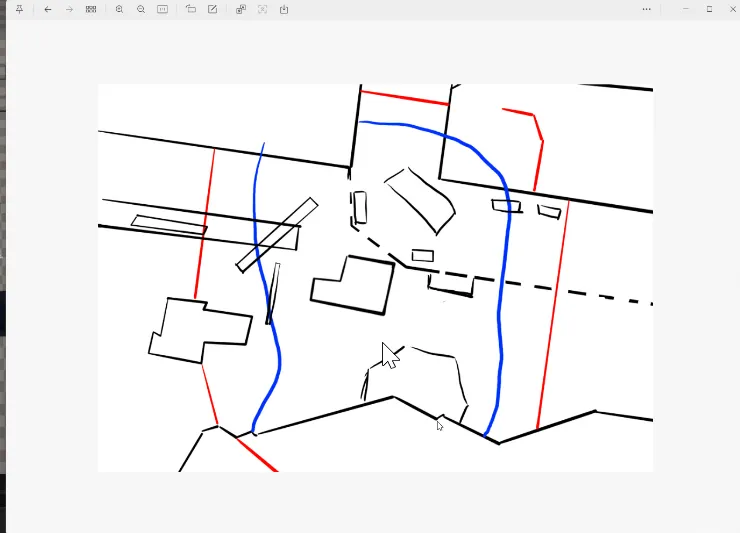
The map started as a relatively flat layout with overly complex routing. In early playtests, it became clear this structure didn’t serve a fast-paced 2v2 experience: rotations were noisy, decision-making was overloaded, and fights often dissolved into unpredictable crossfires.
To address this, I stretched the map’s footprint while preserving key thematic elements, then re-authored player routes so that, at most decision points, players typically face two clear options rather than a cluster of competing paths. This keeps choices meaningful and readable—commit to a lane, or rotate—without turning the map into a maze.
Cover was also a major issue. The initial blockout had excessive cover density, which not only complicated movement but also conflicted with COD-style locomotion and combat cadence. I reduced clutter and opened up select spaces to better support slides, dives, and aggressive re-peeks, giving players room to express mechanics without sacrificing sightline control. The result is a cleaner combat rhythm: clearer engagements, faster resets, and more deliberate, high-tempo decisions.

